
UTC to CST Caribbean Converter
Start by searching for a time zone, city, or town.
Add one or more places to compare local times, adjust the date, and share the result.
Quick answers
Selected conversion
12:00 pm12:00 UTC (UTC+0), Oct 18, 2026 = 8:00 am08:00 CDT (UTC-4), Oct 18, 2026
UTC is 4 hours ahead of CDT.
UTC and CST examples
These examples always use UTC (UTC+0) and CST (UTC-5). They stay the same when you change the date or time above. The selected conversion may differ when daylight saving time applies.
UTC is 5 hours ahead of CST.
How the time difference changes
For most of the year, UTC is 4 hours ahead of CDT Caribbean. From Nov 1, 2026 to Mar 14, 2027, UTC is 5 hours ahead of CST Caribbean.
For most of the year, working hours of 9:00 am to 6:00 pm in UTC correspond to 5:00 am to 2:00 pm in CDT Caribbean. At other times of the year, working hours of 9:00 am to 6:00 pm in UTC correspond to 4:00 am to 1:00 pm in CST Caribbean.For most of the year, working hours of 09:00 to 18:00 in UTC correspond to 05:00 to 14:00 in CDT Caribbean. At other times of the year, working hours of 09:00 to 18:00 in UTC correspond to 04:00 to 13:00 in CST Caribbean.
Compare UTC time with CST time, including current local time, UTC offsets, time difference, daylight saving changes, working hours, and shareable meeting times.
Time Difference
Coordinated Universal Time is 4 hours ahead of Cuba Daylight Time.
12:00 pm12:00 in UTC is 8:00 am08:00 in CDT
UTC to CDT call time
Best time for a conference call or a meeting is between 1pm-6pm13:00-18:00 in UTC which corresponds to 9am-2pm09:00-14:00 in CDT
12:00 pm12:00 Coordinated Universal Time (UTC). Offset UTC 0:00 hours
8:00 am08:00 Cuba Daylight Time (CDT). Offset UTC -4:00 hours
12:00 pm12:00 UTC / 8:00 am08:00 CDT
Choose an hour to update the converter. Day labels such as “next day” or “+1” are relative to the selected date in the first column. Use Up and Down arrow keys, Home or End to move between hours, then Enter or Space to select.
| UTC | CDT |
|---|---|
| 8:00pm previous day | |
| 9:00pm previous day | |
| 10:00pm previous day | |
| 11:00pm previous day | |
| 12:00am | |
| 1:00am | |
| 2:00am | |
| 3:00am | |
| 4:00am | |
| 5:00am | |
| 6:00am | |
| 7:00am | |
| 8:00am | |
| 9:00am | |
| 10:00am | |
| 11:00am | |
| 12:00pm | |
| 1:00pm | |
| 2:00pm | |
| 3:00pm | |
| 4:00pm | |
| 5:00pm | |
| 6:00pm | |
| 7:00pm | |
| 20:00 previous day | |
| 21:00 previous day | |
| 22:00 previous day | |
| 23:00 previous day | |
| 00:00 | |
| 01:00 | |
| 02:00 | |
| 03:00 | |
| 04:00 | |
| 05:00 | |
| 06:00 | |
| 07:00 | |
| 08:00 | |
| 09:00 | |
| 10:00 | |
| 11:00 | |
| 12:00 | |
| 13:00 | |
| 14:00 | |
| 15:00 | |
| 16:00 | |
| 17:00 | |
| 18:00 | |
| 19:00 |
Coordinated Universal Time
Offset: UTC is the same as Greenwich Mean Time (GMT).
Countries using this time zone: Antarctica, Burkina Faso, Faroe Islands, Gambia, Ghana, Greenland, Guernsey, Guinea, Guinea-Bissau, Iceland, Ireland, Isle of Man, Ivory Coast, Jersey, Liberia, Mali, Mauritania, Morocco, Portugal, Saint Helena, São Tomé and Príncipe, Senegal, Sierra Leone, Spain, Togo, United Kingdom, Western Sahara
Principal Cities: The largest city in the UTC time zone is London in the United Kingdom, with about 8.962 million people. Other major cities in this time zone include Abidjan, Bamako, Casablanca, Dakar.
Coordinated Universal Time (UTC) is the world time standard that regulates clocks and time. It is the successor to Greenwich Mean Time (GMT). For casual use, UTC is the same as GMT, but UTC is the standard the scientific community uses.
UTC has been the time standard commonly used across the world since 1972. It is used in many technical fields, such as aviation and meteorology, and to synchronize time across internet networks.
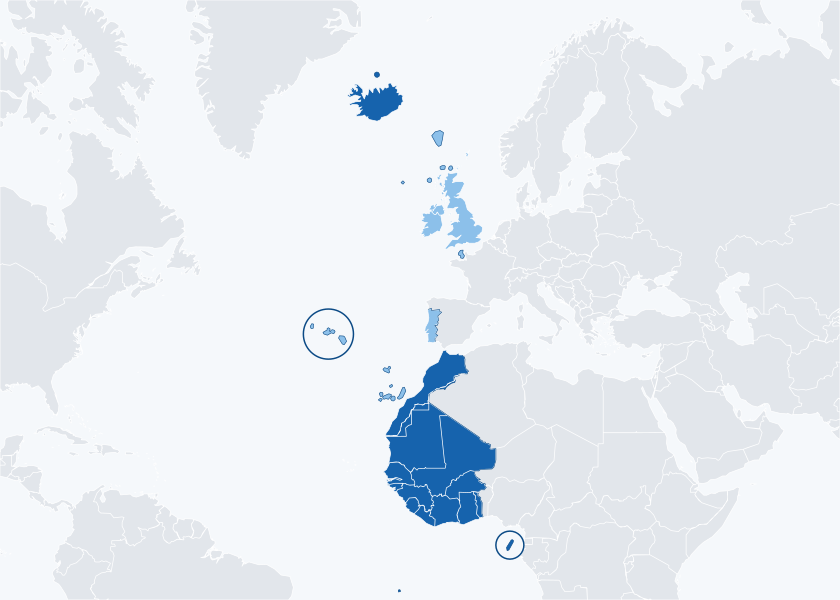
Today some of the lighter areas are on UTC+1 (British Summer Time, Irish Standard Time, WEST).
UTC representations, usage and related time zones
- Z - is the zone designator for the zero UTC/GMT offset, also known as 'Zulu' time
- +00 - basic short
- +0000 - basic
- +00:00 - extended
- +0000 - sign character (+) followed by a four digit time providing hours (00) and minutes (00) of the offset. Indicates the zero UTC/GMT offset.
- Zulu - Military abbreviation for UTC
- Z - short form of 'Zulu'
- Etc/UCT
- Etc/UTC
- Etc/Universal
- Etc/Zulu
- UCT
- UTC
- Universal
- Zulu
- EGST - Eastern Greenland Summer Time
- GMT - Greenwich Mean Time
- WET - Western European Time
- AZOST - Azores Summer Time
- UTC - Coordinated Universal Time
- WT - Western Sahara Standard Time
- Z - Zulu Time Zone
Cuba Standard Time
Offset: CST is 5 hours behind Greenwich Mean Time (GMT).
Countries using this time zone: Cuba
Principal Cities: The largest city in the CST time zone is Havana in Cuba, with about 2.164 million people. Other major cities in this time zone include Santiago de Cuba, Camagüey, Holguín, Guantánamo.
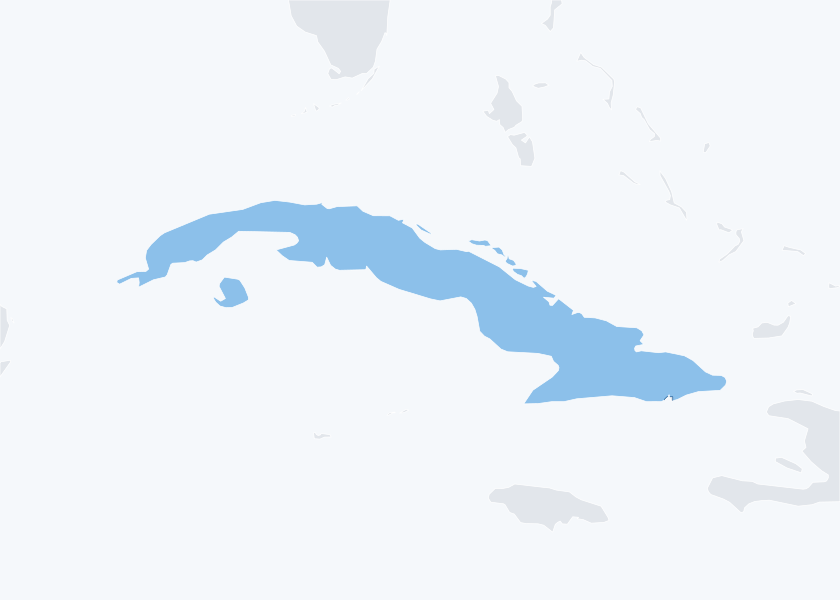
Today the shaded areas are on UTC−4 (Cuba Daylight Time).
Daylight Saving: This is a standard time zone. During summer, some places set clocks forward one hour for daylight saving time and observe Cuba Daylight Time (CDT).
End: Cuba Standard Time (CST) ended on Sunday, March 8, 2026 at 12:00 am00:00 local time and clocks were set one hour forward to Sunday, March 8, 2026, 1:00 am01:00 local daylight time instead. Standard time ends annually on the second Sunday of March.
Start: Cuba Standard Time (CST) starts on Sunday, November 1, 2026 at 1:00 am01:00 local time and clocks are set one hour back to Sunday, November 1, 2026, 12:00 am00:00. Standard time starts annually on the first Sunday of November.
See Cuba daylight saving time and upcoming clock changes worldwide.
CST representations, usage and related time zones
- -05 - basic short
- -0500 - basic
- -05:00 - extended
- -0500 - sign character (-) followed by a four digit time providing hours (05) and minutes (00) of the offset. Indicates an offset of five hours to the west of the zero meridian.
- Romeo - Military abbreviation for CST
- R - short form of 'Romeo'
- America/Havana
- Cuba
- Central Standard Time - UTC -6
- China Standard Time - UTC +8
- Cuba Standard Time - UTC -5
- CDT - Central Daylight Time
- EST - Eastern Standard Time
- ET - Eastern Time
- COT - Colombia Time
- CST - Cuba Standard Time
- EASST - Easter Island Summer Time
- ECT - Ecuador Time
- PET - Peru Time
- R - Romeo Time Zone